- Esther's Letters
- Posts
- Where Are You Being Dishonest With Yourself?
Where Are You Being Dishonest With Yourself?
This is where chronic resentment begins.

Esther Levy
March 01, 2026
No One’s Coming to Save You
Letter #5: Where Are You Being Dishonest With Yourself?
There’s a conversation we don’t have often enough.
Not about what other people are doing wrong.
Not about who failed us.
Not about who didn’t show up.
But about where we stopped being honest with ourselves.
The word narcissism gets thrown around easily these days. It’s used to describe selfishness, entitlement, lack of empathy. But there’s a quieter, less dramatic version that lives closer to home.
It’s the dishonesty we practice with ourselves.
The subtle way we abandon what we know.
The way we override our own reality.
The way we pretend something is possible long after the math says it isn’t.
There’s an example that’s often shared. If you ask a nine-year-old girl what she wants on her pizza, she’ll tell you. Peppers. More cheese. Olives. She knows. If you ask a twelve-year-old, she might hesitate. “I don’t know.” By fifteen, she may say, “Whatever you want.”
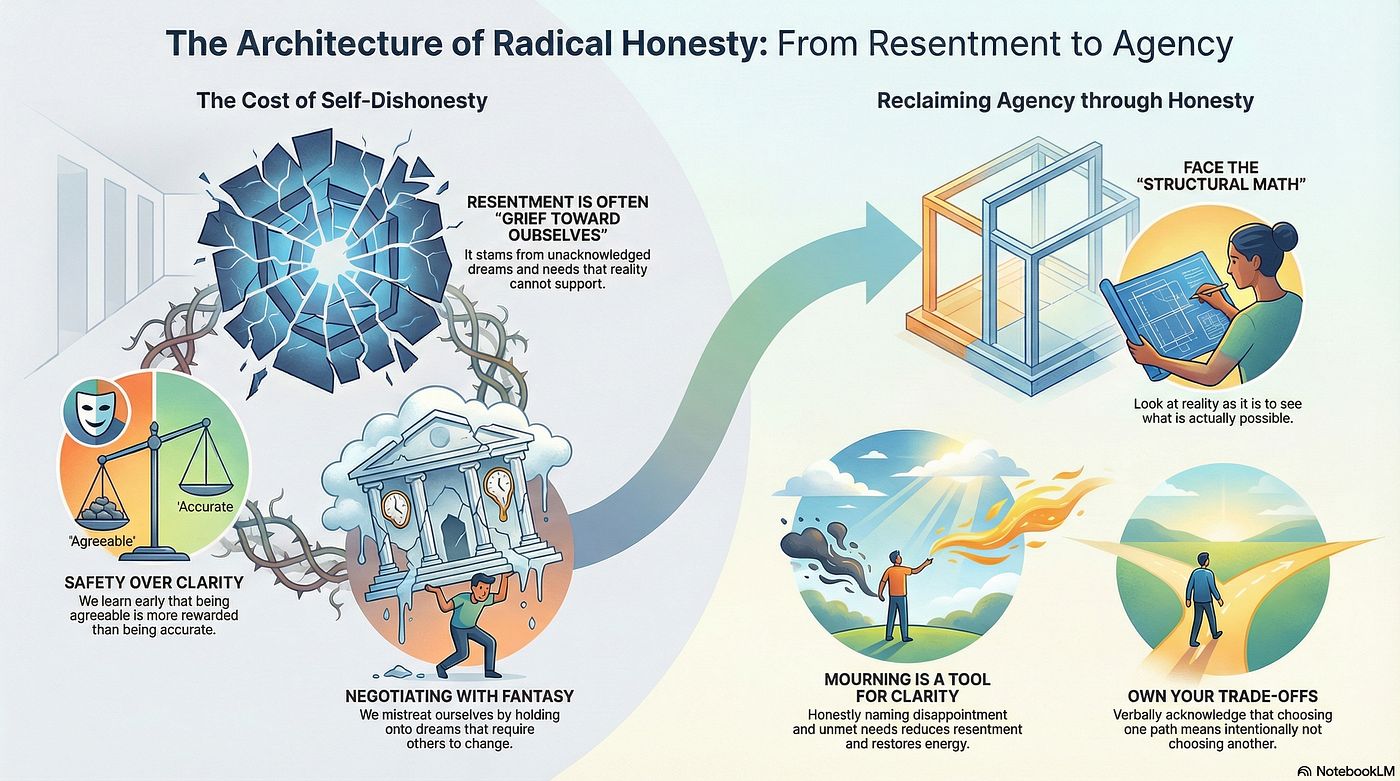
Nothing catastrophic happened in those three years. But something shifted. Approval began to matter more than preference. Safety began to matter more than clarity. And slowly, self-honesty became negotiable.
Many women learn early that harmony is safer than accuracy. That being agreeable is rewarded. That knowing what you want can feel risky. Over time, this doesn’t just affect communication. It affects identity.
And this is where chronic resentment begins.
Resentment is often framed as anger toward others. But sometimes resentment is grief toward ourselves. Grief for the dreams we never named honestly. Grief for the needs we knew couldn’t be met but kept trying to force. Grief for the version of life we imagined that reality simply does not support.
No one abused us.
No one sabotaged us.
But something did not — and perhaps will not — unfold the way we hoped.
And that requires mourning.
Recently, I came to terms with a dream I carried for years. I did the work. I invested time, energy, intention. And I had to face a difficult truth: the probability of that specific vision developing the way I imagined is low. Not impossible — but unlikely. That realization didn’t come with drama. It came with grief. A quiet acknowledgment that this version of my life may not exist.
Nobody failed me.
But I had to be honest.
Honesty, in this context, doesn’t mean “speaking your truth” impulsively or demanding what cannot be given. It means looking at reality as it is. Looking at the statistics. Doing the math. Seeing what is structurally possible and what is not.
At the same time, honesty also means validating your emotions. Naming the disappointment. Naming the longing. Naming the unmet need. Without shame.
The question becomes: where in your life are you trying to manipulate a situation to get something very specific — and then turning your frustration toward someone else when it doesn’t materialize?
Where are you holding on to a dream that requires someone else to change in ways they have not shown capacity for?
Where are you mistreating yourself by refusing to mourn what may not happen?
Try this: make a list of what you are actually feeling. Not what you think you should feel. Not what sounds mature. What is actually there.
Then ask yourself, realistically: which of these needs can be met? And which cannot?
This is not pessimism. It’s design.
Because once you see clearly what is and isn’t possible in your current structure, you regain agency. You stop negotiating with fantasy. You start choosing consciously.
And choosing always comes with trade-offs.
An athlete cannot optimize for every modality at once. Certain forms of training complement each other. Others conflict. If you choose one, you temporarily forfeit another. That isn’t failure — it’s focus.
You cannot maintain a dramatic, chaotic social circle and expect to go to bed every night with a clear, regulated nervous system. You cannot demand deep rest while choosing constant stimulation. You cannot ask for stability while feeding volatility.
Every choice gains something and forfeits something else.
The question isn’t, “Why can’t I have it all?”
The question is, “What am I choosing — and what does that choice cost?”
And then, perhaps the most mature move of all:
Say it out loud to yourself.
I am choosing this.
And because I am choosing this, I am not choosing that.
No one is coming to save you from your own choices.
But that also means no one is preventing you from making different ones.
This is Letter #5 in the series No One’s Coming to Save You — an invitation to radical, compassionate honesty. Not to judge yourself. Not to shame yourself. But to stop outsourcing your reality.
Clarity reduces resentment.
Honesty restores life force.
With care,
Esther

If you’ve been reading these letters over the past few years, I’d love to hear from you.
Has something shifted for you?
Has a sentence stayed with you?
Has a letter helped you make a decision, sit with discomfort, or see yourself differently?
Writing these takes time, thought, and emotional labor. It’s work I care deeply about — and it’s something I show up for consistently.
If these letters have impacted your life in any way, the greatest support you can offer is simple:
• Share this with a friend who would benefit.
• Invite someone to subscribe.
• Or, if you feel called to financially support this work so I can continue publishing and expanding it, reach out to me directly. Every contribution makes a difference.
This is a community built on growth — and growth is always reciprocal.
Esther